
💡 SPOTLIGHT
Maduro makes a mockery of democracy — and Latin America's left goes along for the ride
With a sham court ruling, Venezuela's President Nicolás Maduro has paved the way for his unchallenged reelection as president this year, regardless of U.S. sanctions. This is happening as Latin America's leftist governments, notably Brazil, watch in silence, writes Marcelo Cantelmi in Argentine daily Clarín.
The brutality of Venezuela's socialist regime is usually a measure of its weakness. Seemingly as its prospects worsen, it has returned, instinctively, to the tried-and-tested formula of ruling by force.
It is how the so-called Bolivarian revolution has run Venezuela for 25 years. And its claims of being revolutionary and ruling for the people are merely to allow it the type of rights violations immediately pounced on should they occur in any right-wing regime. Like this last one: without a peep from anyone in Latin America, Venezuela's commissar-filled Supreme Court banned the government's chief opponents, notably the leading presidential aspirant María Corina Machado, from running for public office.
This was a crass reversal of the regime's earlier bid to ingratiate itself with the United States and give the economy a breather. A conditional agreement in October (to allow opponents to compete in elections) broadly alleviated U.S. sanctions, allowing business to pick up a little, before this return to the "Nicaraguan" path of brazen despotism. Here President Nicolás Maduro chose to heed the counsels of hardliners led by the deputy-head of the ruling party and captain in the Armed Forces, Diosdado Cabello.
The volte-face has been justified with the usual litany of claims on attempted coups and CIA plots to murder Maduro. It's the side dish in a familiar recipe.
The reason was the regime's sullen realism. It is the first time that elections could sweep away — or bring crashing down — the socialist edifice its ideologue, the late Hugo Chávez, began raising in 1999. The regime was already showing restlessness when it revived months ago a 19th century dispute over Esequibo, an oil-rich chunk of land inside neighboring Guyana. Threatening to march into the territory was a jingoistic ploy any troubled regime would try, especially as Venezuelans already believe Esequibo is 'rightly' part of their country.
Esequibo is a little like our drama with the Falkland Islands, which we call Malvinas, although Guyana became independent of Great Britain in 1966 and the land dispute is now with the International Court at The Hague. Perhaps it is more like Kuwait, the oil-drenched emirate Iraq's dictator Saddam Hussein briefly annexed in 1990. He was hoping, in vain, to solve Iraq's dismal economic conditions in one fell swoop. Likewise Maduro may envisage he could bankroll a Bolivarian renaissance with Esequibo's resources. Thanks to those, Guyana's economy grew 57.8% in 2022, and 29.2% in 2023. Thus he held a referendum on Dec. 3 wherein voters were asked to reaffirm this claim, though its chief result turned out to be their abstention.
Less than 10% of almost 21 million eligible voters voted that day, which is fewer than the disciplined opposition supporters who voted last June to make Machado the opposition's single candidate at the presidential elections due this year. The regime previously received a slap in the face in the 2022 local elections in the state of Barinas, Chávez's birth state, where the opposition won. Rather, two slaps: the Supreme Court annulled the results, ordered a repeat with other opposition candidates, and the opposition won again! [...]
— Read the full article by Marcelo Cantelmi for Clarín, translated into English by Worldcrunch.
🌎 7 THINGS TO KNOW RIGHT NOW
• Truce talks in Cairo as Rafah attacks intensify: U.S., Egyptian, Israeli and Qatari senior officials are expected to meet in Cairo on Tuesday for the latest round of discussions on a truce in Gaza as fear of an Israeli assault on Rafah, where more than a million civilians are sheltering, is growing. China urged Israel to stop its military operation “as soon as possible,” warning of a “serious humanitarian disaster,” while U.S. President Joe Biden said civilians there must be “protected.”
• U.S. Senate begins vote to pass Ukraine, Israel aid bill: The U.S. Senate started voting on an alternative bill to pass a $95.34 billion aid package for Ukraine, Israel and Taiwan, following criticism of House Speaker Mike Johnson which casted doubts about the future of the bill. The Republican speaker said the bill does not address the “most pressing” issue of security at the U.S.-Mexico border.
• Russian puts Estonian Prime Minister Kaja Kallas on “wanted” list: Russian police have put Estonian Prime Minister Kaja Kallas, its state secretary and Lithuania's culture minister on the Interior Ministry’s register of people wanted in connection with criminal charges. It is the first time the Russian ministry has put a foreign leader on a wanted list. Kremlin spokesman Dmitry Peskov said Kallas is wanted for “desecration of historical memory.” Meanwhile, Estonia's Foreign Intelligence Service warned on Tuesday that Moscow is preparing for a military confrontation with the West within the next decade.
• Four Armenian soldiers killed by Azerbaijani fire amid peace talks: Armenia said on Tuesday that four of its soldiers were killed in a fire fight with Azeri forces on the two countries’ shared border, in the first fatal incident since they began negotiating a truce to end a 30-year conflict over the Nagorno-Karabakh region. The longtime Caucasian rivals accused one another of sparking the incident.
• Indian police fire tear gas as protesting farmers march on Delhi: Police in northern India have fired tear gas in a bid to stop thousands of protesting farmers marching on New Delhi after talks with the government failed. The farmers are demanding greater support and guaranteed crop prices in a repeat of the 2020 protests, which saw protesters camping on the capital’s outskirts for more than a year.
• Thailand’s jailed former Prime Minister Thaksin Shinawatra to be released: Former Thai prime minister Thaksin Shinawatra, who was sentenced for eight years for abuse of power before a royal pardon reduced the term to one year, was granted release on parole and will soon be freed. The controversial billionaire, twice elected premier and ousted in a 2006 military coup, had been sentenced just after he returned to Thailand from a 15-year self-imposed exile in August 2023.
• UAE, Azerbaijan, Brazil to fight global warming jointly with climate “troika”: Past and future UN climate summit hosts the United Arab Emirates, Azerbaijan and Brazil announced on Tuesday they will form a “troika” aiming at pushing for an international agreement to limit global warming to 1.5 °C.
🗞️ FRONT PAGE
📰 STORY OF THE DAY
How the Centre Pompidou's original sketches were rediscovered — in a parking lot
In Turin-based daily La Stampa, Andrea Plebe reports on the discovery of four hundred tubes that tell the story of the architectural adventure of the making of the iconic post-modern Centre Pompidou, which is about to undergo a major renovation project as its 50th anniversary approaches.
📄 "It was like entering Ali Baba's cave..." Boris Hamzeian, an architect and architectural history and theory scholar, was born in Sestri Levante, Italy, to a family of Iranian descent. But the mysterious "cave" in question was in Paris, hidden inside the parking lot next to the Centre Georges Pompidou. There were 400 tubes, containing the original drawings of the revolutionary project with which Renzo Piano, Richard Rogers and Gianfranco Franchini, then in their early 30s, submitted the winning bid to design and build an icon of 20th-century architecture.
🏗️ The Beaubourg marks a watershed in the conception of museums: no longer courtly, intimidating buildings, the expression of a dusty, academic culture, but instead a center that aimed to be open to as many people as possible. A kind of cultural factory descended upon the center of the French capital, with its green, yellow, blue and white exterior tubes, plus red to indicate the paths and escalators on the main facade. Some people called it pejoratively at the time the "Notre Dame of tubes."
🥇 The competition was announced in 1971, the inauguration was held on January 31, 1977 with the intervention of the President of the Republic, Valéry Giscard d'Estaing (Georges Pompidou, who conceived the idea and after whom the center is named, had died in 1974): 5,000 people were expected, 30,000 arrived. On July 15, 1971, when the name "Piano & Rogers" was read out by the chairman of the competition jury, Jean Prouvé, as the designated winners from among 681 proposals received from 41 countries around the world, no one had any idea who they were.
➡️ Read more on Worldcrunch.com
📹 THIS HAPPENED VIDEO — TODAY IN HISTORY, IN ONE ICONIC PHOTO

#️⃣ BY THE NUMBERS
123.4 million
According to figures from CBS, which aired the game, Super Bowl LVIII was the most-watched television broadcast since the Apollo 11 Moon landing in 1969, with an estimated 123.4 million viewers. In addition to CBS, the game (which saw the Kansas City Chiefs defeat the San Francisco 49ers) could be watched on Paramount+ streaming platform, Univision, and Nickelodeon. Among the factors cited for the record: a thrilling overtime and U.S. pop icon Taylor Swift in attendance.
📣 VERBATIM
“They need to be protected.”
— U.S. President Joe Biden said that Israel must make "credible" efforts to protect the civilians blocked in Rafah, whom he described as “exposed and vulnerable.” Biden’s comments come after Israel's Prime Minister Benjamin Netanyahu ordered troops to prepare to move into the southern city of Rafah, now home to an estimated one million Palestinians. President Biden called for the protection of Rafah civilians after meeting with Jordan's King Abdullah in Washington on Monday, stating that any major military operation in the city "should not proceed without a credible plan for ensuring the safety" of those living there. For more, read this recent article from die Welt, translated from German by Worldcrunch: What The U.S. Got Wrong In The Middle East — With Obama, Trump And Biden All To Blame.
📸 PHOTO DU JOUR
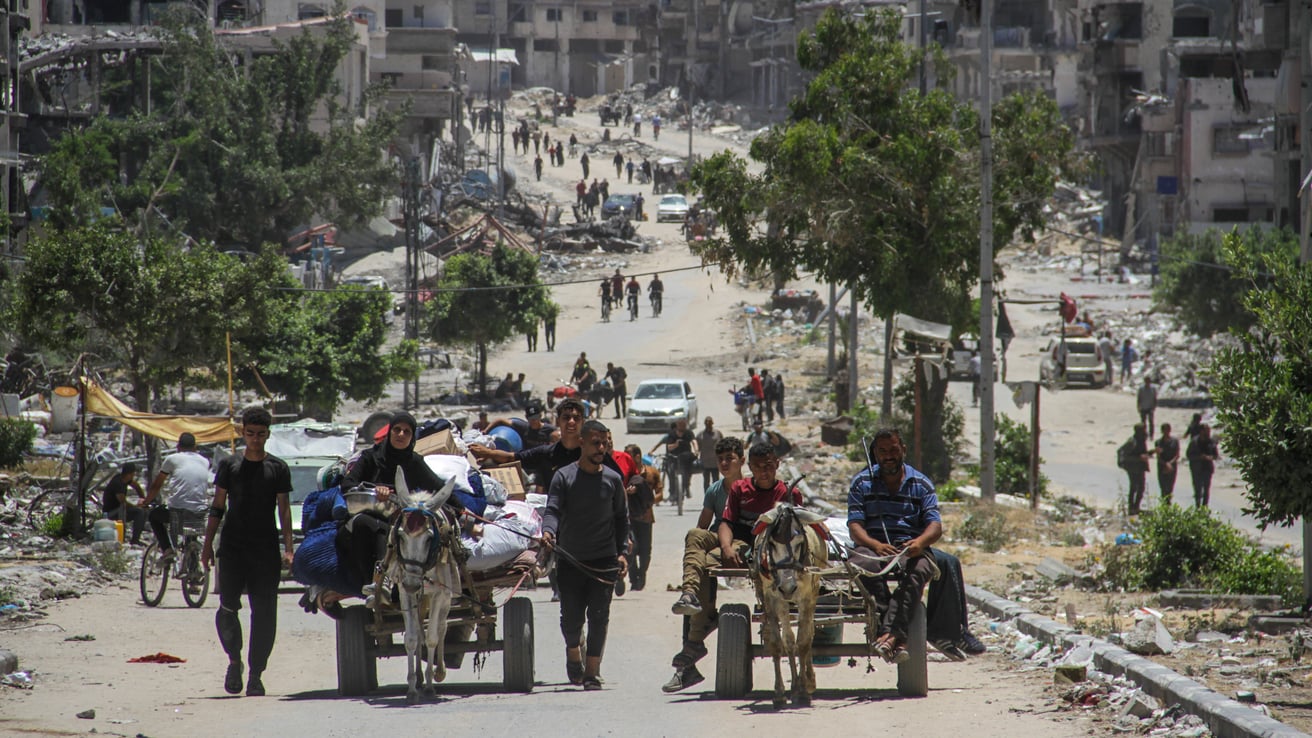
(see above) Palestinians inspect damaged buildings after Israeli airstrikes on Rafah, southern Gaza. On Monday, the Hamas-run health ministry in Gaza said 164 people had been killed within 24 hours across Gaza. — Photo: Abed Rahim Khatib/dpa/ZUMA
👉 MORE FROM WORLDCRUNCH
• Two Burning Questions From Rafah: Where To Now? Where Is Home? — WORLDCRUNCH
• Is A New Frontline In The Ukraine-Russia War Opening — In Sudan? — DIE WELT
• Indonesian Elections: The Dark Reality Behind Subianto's "Cute Grandpa" Memes— THE CONVERSATION
✅ SIGN UP
Check out and subscribe to Worldcrunch’s other newsletters: 👉Sign up here
✍️ Newsletter by Anne-Sophie Goninet and Agnese Tonghini