

💡 SPOTLIGHT
Milei's folly: Argentina will pay a real price for bad-boy diplomacy
Argentina's erratic right-wing president Javier Milei, seems to emulate Trump and Bolsonaro. But he has taken his bad diplomacy to a new level after the recent spat with Spain's Socialist party prime minister Pedro Sánchez, writes Juan Pablo Lohlé in Argentine daily Clarín.
Argentine President Javier Milei's recent visit to Spain, the third since his election last November, raised questions — and eyebrows — on both sides of the Atlantic. Nobody was expecting cordiality as Milei is brazenly right-wing and Spain has a socialist government led by prime minister Pedro Sánchez. But to visit a country for an opposition event without meeting anyone from the government is certainly unusual, if not outright inappropriate.
Milei was in Madrid to attend a noisy gathering of right-wingers arranged by Spain's far-right party Vox. Its leader, Santiago Abascal, one of Spain's more abrasive politicians, backed Milei as candidate last year as Spanish Socialists backed the Peronist candidate, Sergio Massa.
The right-wing jamboree included other questionable guests like France's Marine Le Pen, head of the National Rally party, Chile's twice-presidential candidate José Antonio Kast and virtual participants like Italy's conservative prime minister, Giorgia Meloni. A few Argentines living in Madrid also attended. It was timed just ahead of European parliamentary elections, where polls suggest the far right may tally record support.
This was neither an official nor a state visit, but rather a calculated gesture of Trumpian tactlessness from the "chainsaw" president. Spain has a king, a prime minister and a parliament, but Milei only had private and partisan meetings. Efforts to meet with the monarch Felipe VI proved fruitless "for scheduling issues." [...]
— Read the full article by Juan Pablo Lohlé for Clarín, translated into English by Worldcrunch.
🗞️ FRONT PAGE
🌎 7 THINGS TO KNOW RIGHT NOW
• Israeli airstrikes kill at least 35 Palestinians and wound dozens in Rafah. The strikes came two days after the International Court of Justice ordered Israel to immediately halt its military operation in Rafah, where hundreds of thousands of civilians are still sheltering. The Israel Defense Forces (IDF) said it had targeted two senior Hamas leaders at one of the group's compounds and would review reports that fire had spread to shelters, harming civilians. Over the weekend, Hamas fired eight rockets from Rafah toward Tel Aviv, the first long-range attacks on the Israeli city since January.
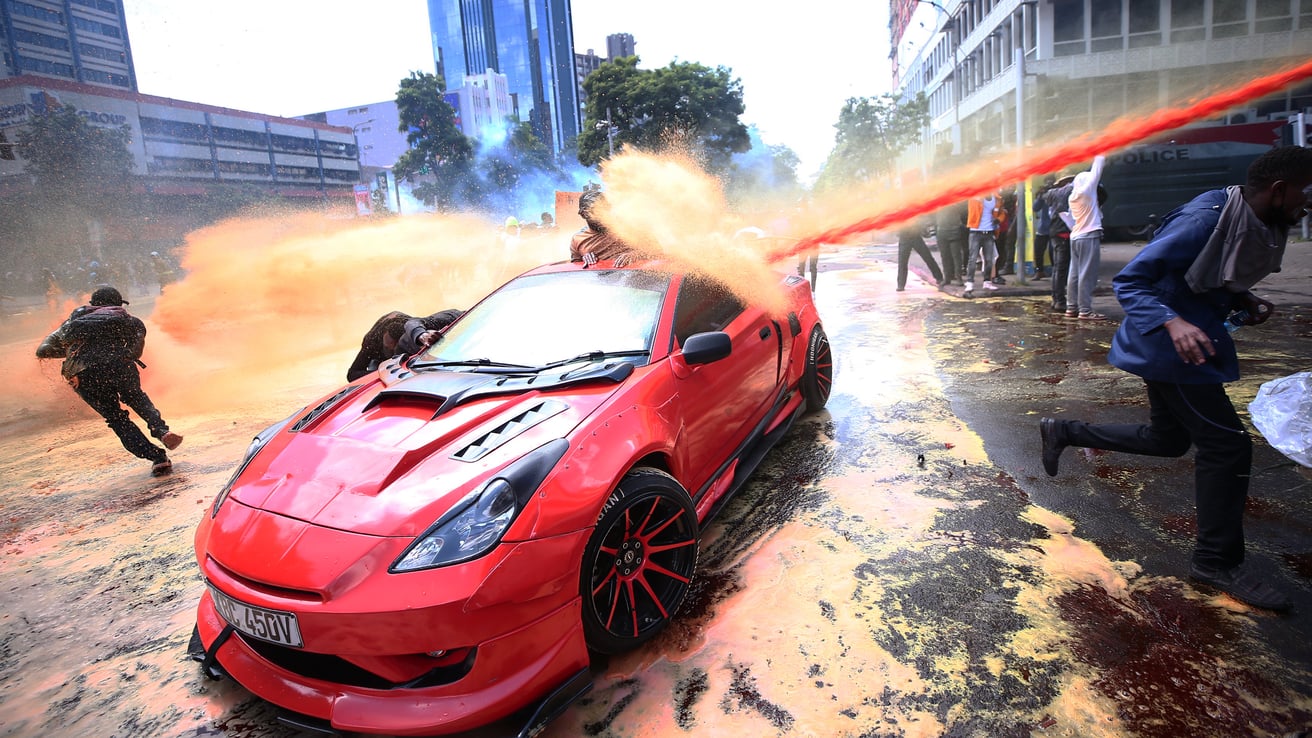
• France announces it will lift the state of emergency in New Caledonia on Tuesday morning. This comes after two weeks of violence over plans to change the rules for provincial elections in France’s Pacific island territory. The Elysee Presidential Palace said in a statement that some 480 more law enforcement officers would be deployed to New Caledonia, as reinforcement for the 3,000 security personnel already on the ground. For more on what’s happening in New Caledonia, read this analysis translated from French to English by Worldcrunch.
• Chinese Premier Li Qiang praised a restart in relations with Japan and South Korea. Li met with South Korean President Yoon Suk Yeol and Japanese Prime Minister Fumio Kishida in Seoul on Sunday for the first three-way talks in four years, agreeing to revive trade and security dialogues previously affected by global tensions.
• Papua New Guinea says last week’s landslide buried more than 2,000 people. In a letter to the UN released on Monday, the Pacific island nation’s National Disaster Center revised the toll, previously set by a separate UN agency at 670. Given the treacherous nature of the terrain and the difficulty of getting aid to the site, few survivors are expected to be found.
...