

💡 SPOTLIGHT
With Russia's backing, Serbia eyes the “right time” for a new war with Kosovo
Serbian President Aleksandar Vučić cooperates closely with Russia, including on security and arms issues. Now he is threatening to invade Kosovo, which Serbia does not recognize as an independent country. If Donald Trump were to win, and NATO to weaken, Vucic may be ready to move, writes Carolina Drüten in German daily Die Welt.
"We will wait for the right time and seize our opportunity..." That was the ominous warning last weekend of Serbian President Aleksandar Vučić at the prospect that the West puts its weight firmly behind Kosovo as the longstanding Balkan conflict continues to heat up.
It's worth noting that Vučić had already spoken admiringly in December of the current and previous presidents of Azerbaijan, who had waited a total of 27 years for the "right time" and geopolitical circumstances to recapture Nagorno-Karabakh. Already, last September, Vučić deployed Serbian troops on the border with Kosovo after Serbian paramilitaries attacked Kosovar police officers and entrenched themselves in a monastery.
Against this backdrop, it is difficult to see anything in his latest words other than a threat.
A new Balkan war is not imminent, but the conflict between Serbia and Kosovo has been coming to a head for months. It is about Kosovo's status as an independent nation, which Serbia does not recognize. The EU and the U.S. have been trying to find a solution for years, but the situation is deadlocked.
Does the West have to prepare for a worst-case scenario in the medium term — or are the Serbian president's words just rhetoric?
A U.S. intelligence report warns of an "increased risk" of inter-ethnic violence in the current year — and cites the Serbia-Kosovo conflict as a prime example. "The motivation for Vučić to keep this crisis simmering is great," says Florian Bieber, Head of the Center for Southeast European Studies at the University of Graz.
Russia also has an interest in all of this: as the inner courtyard of Europe, a conflict in the Western Balkans would be devastating for the West.
Vučić basically has three options: a solution, escalation or maintaining the status quo with targeted provocations.
The first option would be for Serbia to recognize Kosovo or at least to normalize relations. But a solution would deprive Vučić of an important issue which he uses in both domestic and foreign policy. Not only is the conflict useful to appeal to nationalist feelings across Serbian society, but it also helps him position himself as a crisis manager in the international context.
The second option — escalation — could play out as an offensive by the Serbian army against Kosovo or the provocation of major riots in the north of Kosovo. This possibility is largely theoretical, because in practice, soldiers from the NATO-led protection force KFOR would immediately intervene and the U.S. would be called into action. In addition, Serbia would forfeit its EU prospects. None of this is in the interests of the government.
That leaves option three: maintaining the status quo with targeted provocations. According to Bieber, Vučić is "stoking tensions so that a subsequent de-escalation back to the status quo is considered a success." In other words: Vucic is both an arsonist and a firefighter.
But there is a great danger that a miscalculation could lead to a conflagration. [...]
— Read the full article by Carolina Drüten for Die Welt, translated into English by Worldcrunch.
🌎 7 THINGS TO KNOW RIGHT NOW
• Israel accuses UN resolution of damaging ceasefire talks, Hezbollah launches strikes: Israel said that Hamas’s rejection of a current proposal for a Gaza truce deal is proof of the “damage” done by the UN Security Council resolution that demanded an immediate ceasefire. The U.S. has dismissed Israel’s claims, saying they were “inaccurate in almost every respect.” Meanwhile, Iran-aligned Hezbollah said it has launched dozens of rockets at Kiryat Shmona, an Israeli border town, killing a civilian, after Israel carried out a deadly strike in south Lebanon.
• Divers to resume search for bodies after Baltimore bridge collapse, data recovered from crashed ship: Divers are expected to resume the search for six missing construction workers, who are now presumed dead, after the U.S. coast guard said they had no hope of finding survivors of the Baltimore bridge collapse. The voyage data recorder from the ship that crashed into the Francis Scott Key Bridge has been recovered by dive crews, as the cause of the incident is still under investigation. The disaster has forced the indefinite closure of the Port of Baltimore, one of the busiest on the U.S. Eastern Seaboard, raising concerns of a “ripple effect” on global supply chains.
• China's Xi Jinping meets U.S. business leaders to restore confidence: Chinese President Xi Jinping has met with American business leaders and academics at Beijing’s Great Hall of the People on Wednesday, as China seeks to woo foreign investments and international firms. This comes after a challenging few years for the world's second-largest economy. Foreign direct investment shrank 8% in 2023 amid concerns over an anti-espionage law, exit bans as well as raids on consultancies. For more on China’s economy, here is an analysis translated from French to English: Billionaires, Jingoists And The Paradox Of China's Economic Slowdown.
• Protests erupt in Hungary after leaked tape hints at corruption: Thousands of protesters took to the streets last night near Budapest’s parliament, after a leaked tape hinted at high-level government corruption. The recording allegedly involves former Justice Minister Judit Varga detailing how Hungary’s Prime Minister Viktor Orbán’s aides and chief of staff interfered in a graft case.
• Tunisia sentences four to death over politician Chokri Belaid’s murder: A court in the Tunisian capital Tunis sentenced four people to death and two to life imprisonment on Wednesday for their role in the assassination of secular opposition leader Chokri Belaid in 2013. The leftist politician was shot dead in his car outside his home, sparking turmoil in the young democracy after the 2011 overthrow of longtime dictator Zine El Abidine Ben Ali.
• Thailand moves closer to legalize same-sex marriage: Thailand's parliament overwhelmingly approved a same-sex marriage bill on Wednesday, paving the way for the kingdom to become the first Southeast Asian nation to recognize LGBTQ marriage equality. The bill still needs approval from the Senate and royal endorsement to become law. That is widely expected to happen by the end of 2024. Read more on LGBTQ+ rights on Worldcrunch.
• Banksy’s London mural under protection: A mural of a tree painted by street artist Banksy in Finsbury Park, in north London, has now been covered with plastic and surrounded by wooden boards after it was defaced with white paint, just two days after it appeared on a residential building. The Islington Council said it wanted the piece “to stay” and that it was discussing solutions with the homeowner “to enable everyone to enjoy the artwork.” Read more about Banksy here.
🗞️ FRONT PAGE
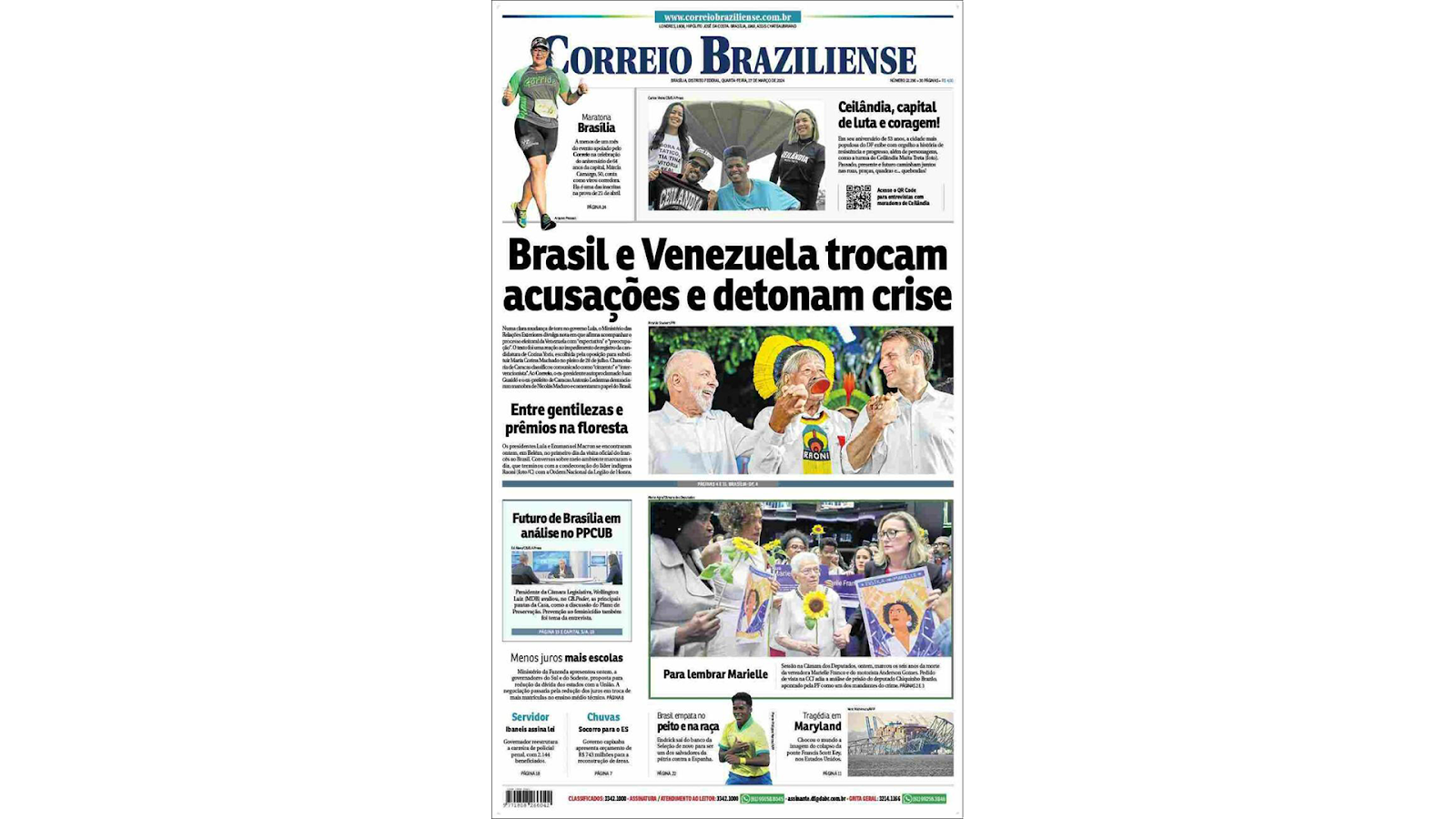
Brasilia-based daily Correio Braziliense features a photo of the meeting between Brazilian President Luiz Inacio “Lula” da Silva, Indigenous leader Raoni Metuktire and French President Emmanuel Macron on its front page. During Macron’s three-day official visit to Brazil, he and his Brazilian counterpart announced a plan to invest 1 billion euros in the Amazon rainforest. The investment project will be a collaboration between Brazilian state banks and France’s national investment agency. The project aims to repair the relationship between the two countries post-Bolsonaro, and deepen cooperation to protect the vital rainforest. Read more about protecting the rainforest on Worldcrunch.
📰 STORY OF THE DAY
A vote at 16? Experiments with lowering the voting age around the world
As Poland considers lowering the voting age to 16, what can other countries' experiences with reducing the voting age teach us about political trends and ralling young constituents?
🗳️ Poland's new Marshal of the Sejm — the speaker of the lower house — and Polska 2050 party leader, Szymon Hołownia has said he intends to lower the country's voting age from 18 to 16. Calling this measure urgent, he says that it is unfair that older Poles take up a disproportionate percentage of the Polish vote, and that adding more young voters will balance the scale. With an aging population akin to much of Europe’s demography, the proportion of older Poles is only expected to rise in the upcoming years.
🇪🇺 Under EU law, member states are free to set their own minimum voting age, including for European elections. While the most popular minimum age is 18, three countries have lowered their voting ages: Greece reduced it to 17 in 2016, Austria to 16 in 2007, and Malta to 16 in 2018. "There is an old democratic principle which states that there should not be any taxation without representation," the National Youth Council told the Times Of Malta, adding that 16 year-olds “should also be able to vote, since they are allowed to work and liable to pay taxes."
✊ While the EU has only recently begun to test the impact of younger voting ages, Brazil lowered its voting age to 16 in 1988. The country has a long history of crucial youth involvement in politics, and student activist movements were critical to bringing down the 21-year military dictatorship in 1985. One-fifth of all 16 and 17 year olds in Brazil registered to vote in the 2022 presidential election, offering much of their support (54%) to elect President Luiz Inacio Lula da Silva. The country continues to hope that younger voters will remain mobilized.
➡️ Read more on Worldcrunch.com
📹 THIS HAPPENED VIDEO — TODAY IN HISTORY, IN ONE ICONIC PHOTO

➡️ Watch the video: THIS HAPPENED
#️⃣ BY THE NUMBERS
$718,750
The floating wooden door prop that played a key role in the end of the 1997 film Titanic, sold at auction for $718,750 in Dallas. The piece of balsa wood was sold at a Heritage Auctions’ Planet Hollywood event, where fans bid on other props and costumes from blockbuster movies. The panel has been the object of intense fan-led debate for decades over whether it was actually too small to fit Leonardo Dicaprio’s character, Jack, alongside Kate Winslet’s character, Rose, as the Titanic sank.
📣 VERBATIM
“The British justice is killing him slowly using purely legal means.”
— Stefania Maurizi, an investigative journalist at Italian daily Il Fatto Quotidiano spoke to Al Jazeera about the UK’s ruling on Julian Assange, the founder of WikiLeaks, where Maurizi had previously worked. A London High Court ruled Tuesday that Assange should be allowed to appeal an order for his extradition to the U.S., unless American prosecutors can ensure that Assange would receive a fair trial and not face the death penalty. Maurizi is one of many free speech advocates who have criticized the British ruling allowing Assange’s extradition, and see the U.S. indictment as a misuse of the 1917 Espionage Act.
📸 PHOTO DU JOUR
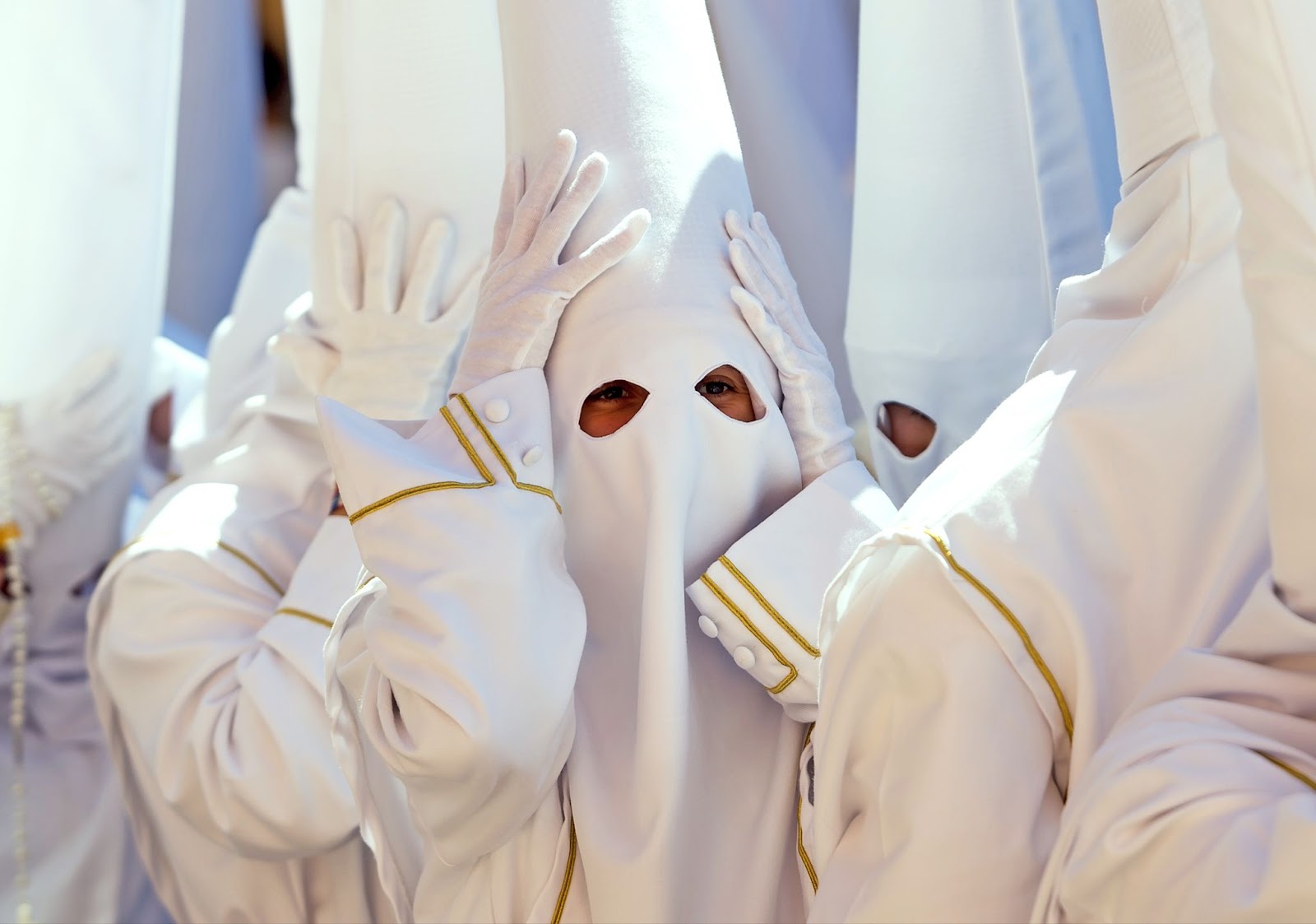
A penitent adjusts his hood as he takes part in a Holy Tuesday procession in Malaga, Spain, where thousands of worshippers wait to see the processions with the statues of Christ and the Virgin Mary as part of the traditional Holy Week celebrations. In Andalusia, Easter brings together crowds from around the world and is considered one of the most important religious and cultural events of the year. — Photo: Jesus Merida/SOPA Images via ZUMA
👉 MORE FROM WORLDCRUNCH
• U.S. And UN: The Abstention That Could Change The Course Of The War In Gaza — FRANCE INTER
• Nigeria, Journey Through The African Giant's Economic Growing Pains — LES ECHOS
• A DNA Bank To Save Jaguars Threatened By Mexico’s Mega Rail Project— GLOBAL PRESS JOURNAL
✅ SIGN UP
Check out and subscribe to Worldcrunch’s other newsletters: 👉Sign up here
✍️ Newsletter by Anne-Sophie Goninet and Katrina Scalise
...