

💡 SPOTLIGHT
Beyond Putin: the national psyche that fuels Russian aggression
Putin, who was just officially reelected as Russia’s president, is just a vessel for a longstanding Russian psychology that is simultaneously expansionist and worried about external threats on the Motherland, writes Yuri Fedorov in Russian independent media Vazhnyye Istorii.
The threat from Russia is often reduced to Vladimir Putin, and there's no denying that he and his inner circle play a crucial role in driving Russian aggression against Ukraine and beyond.
However, the Russian President's enduring power stems from the alignment between his strategic ambitions and the instincts of both the Russian ruling class and mass consciousness.
Putin's policies effectively fulfill the desires that the Russian elite and wider society has for historical vengeance and the resurgence of a dominant Eurasian empire.
In the first two or three years after the collapse of the USSR, it was assumed that Russia would become an ally of the West, weaken the role of the military command in the life of the nation and form a “belt of stability and good neighborliness” along its borders — that, in other words, it would respect the independence and territorial integrity of the independent states that emerged from the Soviet ruins.
This line, put forward by the first Russian Foreign Minister Andrei Kozyrev, faced resistance from the army generals and the military-industrial complex, as well as the state security leadership, and most of the regional elites and academic circles. It was finally buried in 1996, when Yevgeny Primakov, director of the Foreign Intelligence Service, became head of the Ministry of Foreign Affairs.
“Among the security leadership, we were well aware that with the end of the Cold War the concept of “enemy” would not disappear," wrote Primakov. "The leaders of a number of Western countries were acting to prevent Russia from playing a crucial role in stabilizing the former republics of the USSR to avoid rapprochement with the Russian Federation.”
Primakov declared Russia’s most important foreign policy objectives to be opposition to NATO expansion, preservation of the Slobodan Milosevic regime in the former Yugoslavia, and the transformation of the former Soviet states into a strategic hinterland where Russian troops would be stationed for operations “on distant frontiers.”
None of these goals were achieved. But Primakov was able to transform the phobias, ambitions and expectations of the Russian elite into strategic concepts. The current Russian Foreign Minister Sergei Lavrov is right: Primakov is indeed “the author of the key facets of modern Russia’s foreign policy doctrine.”
The outside world was declared a danger, and the main threat to Russia's security was the establishment of a “unipolar world.” Washington was accused of undermining Russia's international influence and pushing it out of its traditional zones of influence and spheres of interest. [...]
— Read the full article by Yuri Fedorov for Vazhnyye Istorii, translated into English by Worldcrunch.
🌎 7 THINGS TO KNOW RIGHT NOW
• West blasts Putin “pseudo” election win: Vladimir Putin’s landslide (88% of the vote) election victory for another six-year term as president was widely denounced by Western officials, with Ukrainian President Volodymy Zelensky adding that the Russian leader “is doing everything to rule forever.” The German MFA called the election a “pseudo-election,” and a White House spokesperson said it was “obviously not free or fair.” Thousands of Alexei Navalny supporters arrived at polling stations in unison at noon on Sunday to protest Putin. Follow Worldcrunch’s coverage of the Russian elections here.
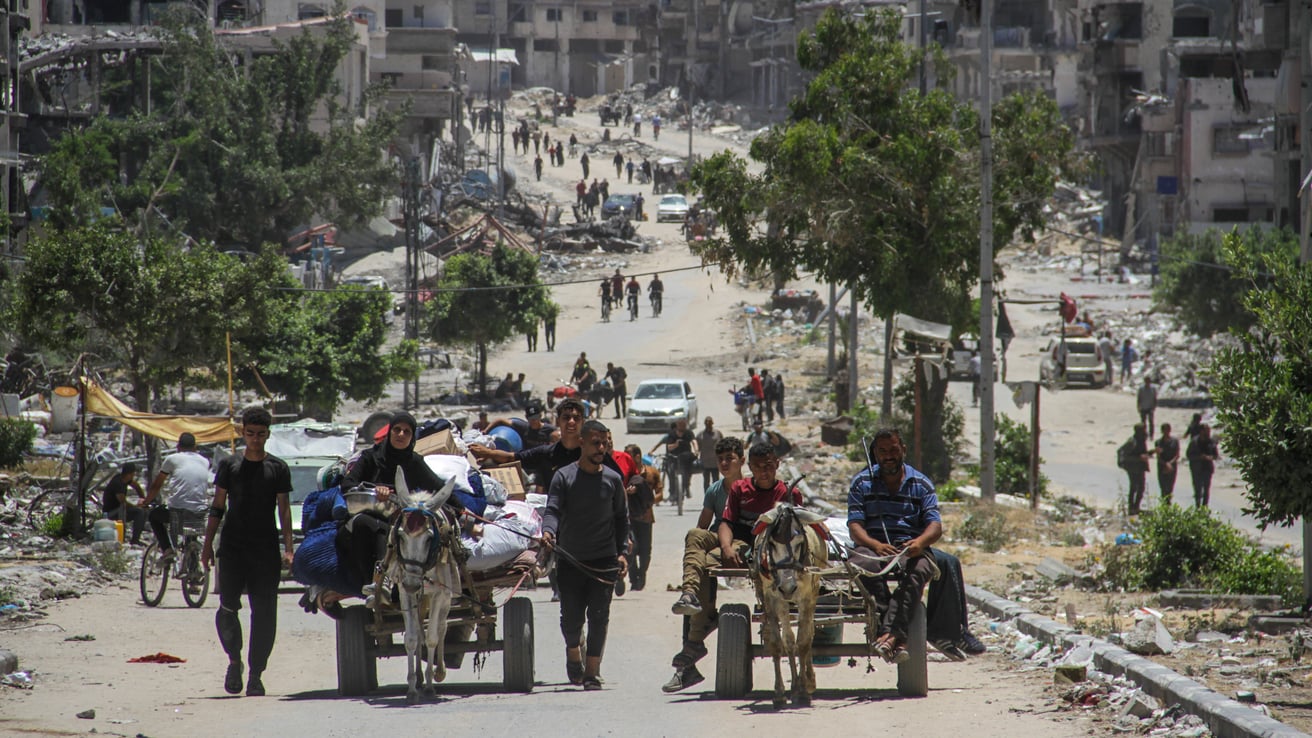
• Israel launches overnight raid on Gaza hospital: Israel Defense Forces carried out an operation to attack “senior Hamas terrorists” that it says regrouped inside Gaza City’s al-Shifa hospital. IDF chief spokesperson Read Adm Daniel Hagari told patients and staff they did not have to evacuate, but eyewitness accounts called the raid “catastrophic.” The Hamas-run Gaza health ministry denounced the operation as a violation of international humanitarian law. Follow Worldcrunch’s coverage of the Middle East here.
• Taliban retaliates against Pakistan military airstrikes: Afghanistan’s Taliban-run government said Monday that Pakistani airstrikes killed five women and three children at the country’s eastern border. Afghan security forces launched heavy weapons in retaliation at the Pakistani military, the Taliban’s defense ministry stated. The strikes follow a recent series of militant attacks in Pakistan, mostly in Khyber Pakhtunkhwa.
• North Korea fires ballistic missiles during Blinken visit to Seoul: North Korea fired short-range missiles into the Yellow Sea, apparently to coincide with U.S. Secretary of State Antony Blinken’s visit to Seoul Monday for a conference on democracy. South Korea called North Korea’s actions “a clear provocation,” and the U.S. State Department and Japanese defense ministry condemned the launches.
• The EU pledges €7.4 billion in aid to Egypt: The European Commission announced a major funding package Sunday in Cairo, with a goal of addressing migrant flows into Egypt from crises affecting other countries in the region. Human Rights Watch said the EU is “rewarding authoritarianism” by working with Egypt, which HRW has accused of mistreating migrants. Follow Worldcrunch’s coverage of the EU and migration.
• Cubans protest shortages: Rare protests broke out this weekend in Santiago de Cuba over electricity and food shortages. Cuba has faced blackouts since the beginning of March because of maintenance to the island’s main thermoelectric plant, leaving some areas without power for up to 14 hours a day. Cuban citizens protested the blackouts and food shortages, which Cuban President Miguel Diaz-Canel said “enemies of the revolution” aimed to exploit. Read more about the Cuban subsidy program on Worldcrunch.
• Berlin music scene becomes UNESCO World Heritage site: The German Commission for UNESCO designated Berlin’s techno music scene as a site of intangible cultural heritage on the German national registry. The capital city’s club music scene, which began in the early 1990s and embodied post-Cold War optimism, has become an established economic contributor to the city. For more from Berlin-based daily Die Welt: Germany's Legendary Clubbing Culture Crashes Museum Space.
🗞️ FRONT PAGE
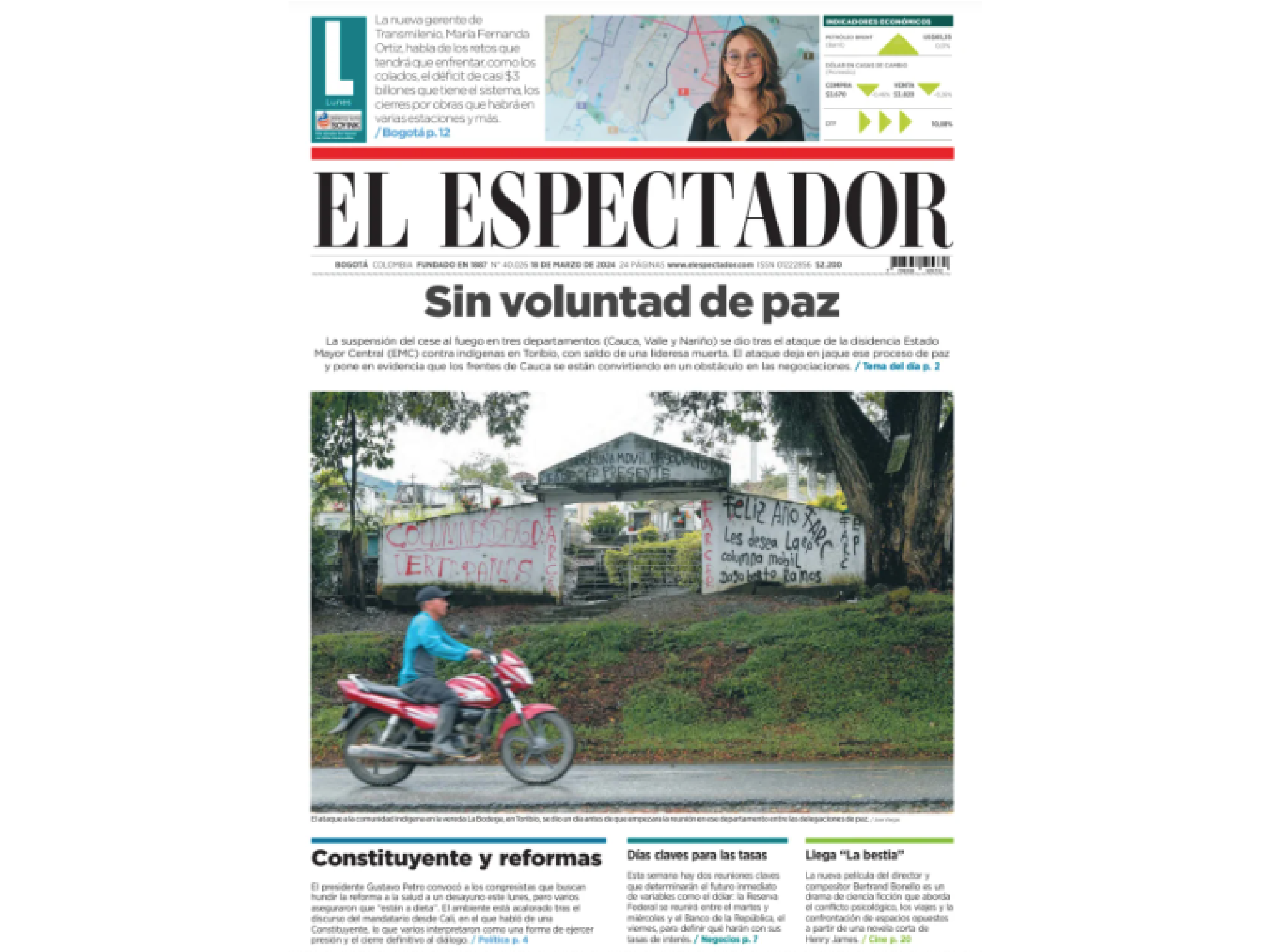
“No will to maintain peace.” Bogota-based El Espectador dedicates its front page to the end of the truce with armed rebels of the Central General Staff (EMC) in three departments in the country: Narino, Cauca and Valle del Cauca. This suspension of ceasefire, signed a year ago between President Gustavo Petro's administration and the dissident faction of the FARC group, follows a series of violent attacks from the guerrillas in these regions, including a strike on an Indigenous group that left one woman dead.
📰 STORY OF THE DAY
La ménopause: how French women are breaking taboos about age and the female body
Long hidden and even seen as shameful, menopause is finally making its way into the public sphere in France, and elsewhere. Celebrities, journalists and sociologists are now talking about it openly, and brands are offering solutions to help reimagine what this physical and psychological change means to some women, reports Jessica Berthereau in Paris-based daily Les Echos.
💬 For some time now, other cultural productions (essays, comics, plays) have been helping French women to “make the menopause visible in the public sphere, outside of just the medical world,” sociologist Cécile Charlap observes. “These are new discourses where women themselves are speaking and giving the floor to other women." In the wake of this, many brands have seized the subject, whether cosmetics, thalassotherapy (the therapeutic use of seawater) or yoga retreats.
⚖️ Having gone through this period herself, author Elise Thiébaut says that she experienced moments of trial and difficulty but also of joy, freedom and opportunity. Incidentally, the latest data from France's National Institute of Health and Medical Research (Inserm) shows that menopause is far from difficult for all women: between a fifth and a quarter of women suffer from severe symptoms that affect their quality of life.
👩 “For me, the menopause does not exist because there is a different menopause for every woman,” says Sophie Kune, who created the Instagram account @menopause.stories in early 2020, four years after she was put into artificial menopause. “Each woman lives through menopause in her own way, according to her culture, her heritage and what she has experienced in her life,” Kune says.
➡️ Read more on Worldcrunch.com
...